
Why Glaze Uniformity Matters in Ceramic Production
Surface glaze is not merely decorative—it defines reflectivity, color tone, and durability.
In industrial settings, glaze uniformity improvement directly impacts product grading, rejection rates, and overall profitability.
Defects such as streaking, orange peel, and uneven thickness often stem from:
-
Inconsistent spray angle or nozzle pressure.
-
Fluctuating glaze viscosity.
-
Uncontrolled temperature and humidity during spraying.
-
Poor airflow or turbulence around the conveyor path.
Achieving uniform coating therefore requires a systematic integration of mechanical precision and process intelligence.
Core Technologies Behind Glaze Uniformity Improvement
| Process Stage | Engineering Focus | Key Technology | Expected Result |
|---|---|---|---|
| Glaze Preparation | Density & viscosity stabilization | Inline agitator + density sensor | ±1% glaze consistency |
| Spraying | Pressure and airflow uniformity | Servo-controlled spray guns | 98% coverage accuracy |
| Conveyor Motion | Stable rotation during coating | Synchronization with robot arm speed | Elimination of over-spray zones |
| Drying | Smooth evaporation without flow marks | Low-velocity laminar airflow dryer | 0% dripping defects |
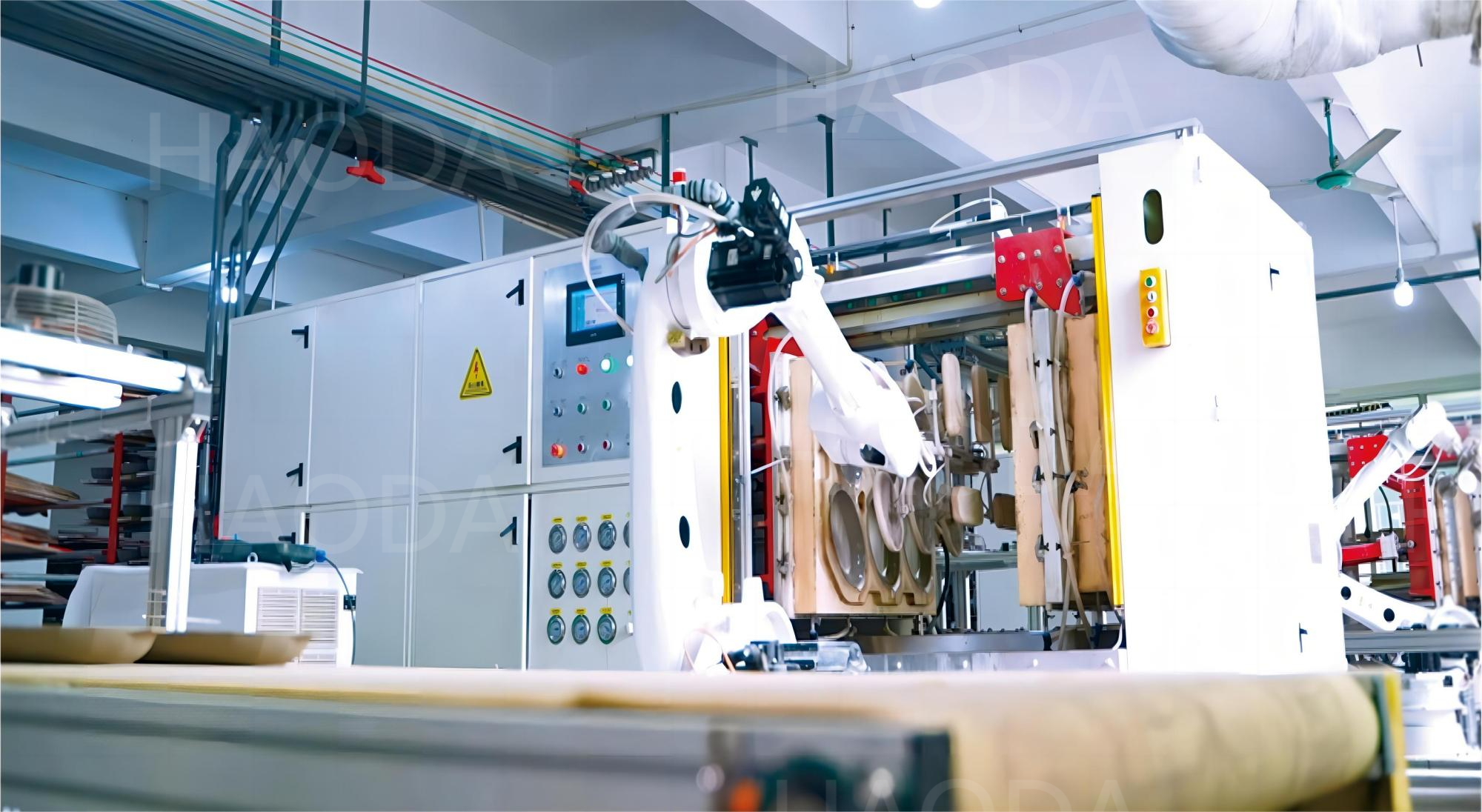
These integrated modules work together in Haoda Machine’s glaze uniformity improvement framework to ensure even coating distribution across both flatware and complex bowl geometries.
Airflow and Nozzle Dynamics
1. Airflow Field Optimization
Air turbulence around the workpiece significantly influences glaze settlement.
By modeling airflow through CFD (Computational Fluid Dynamics), Haoda engineers redesigned the spray booth geometry to maintain consistent laminar flow, cutting overspray by 35%.
2. Nozzle Precision and Synchronization
Each robotic arm uses dual nozzles with feedback-controlled atomization.
An inline pressure sensor maintains stable output between 0.2–0.3 MPa, adapting to glaze viscosity in real time.
| Parameter | Traditional System | Haoda System | Improvement |
|---|---|---|---|
| Thickness Deviation | ±10% | ±2% | 80% reduction |
| Overspray Loss | 25% | <8% | 68% material saving |
| Manual Adjustment Frequency | 5 times/day | 0 | Fully automated |
Glaze Composition and Viscosity Management
A critical factor in glaze uniformity improvement is keeping viscosity within a narrow, stable range.
Haoda Machine applies real-time rheology monitoring, automatically dosing water or deflocculant when deviation exceeds ±2%.
Control Logic Example:
-
Input: Viscosity reading every 15 seconds
-
Threshold: 800–900 mPa·s
-
Action: Adjust water feed rate ±0.3 L/min
-
Output: Uniform coating density and firing smoothness
This approach minimizes glaze settlement at tank bottoms and maintains reproducible color tone across production batches.
Environmental and Humidity Regulation
Even with precise spraying, environmental control remains essential.
The energy saving ceramic line design (see previous article) integrates humidity-controlled booths to stabilize drying speed and prevent run marks.
| Variable | Standard Range | Monitoring Frequency | Control Method |
|---|---|---|---|
| Booth Humidity | 60–70% RH | Every 30 sec | Dehumidifier feedback |
| Booth Temp. | 22–26°C | Continuous | PID temperature loop |
| Air Velocity | 0.8–1.2 m/s | Continuous | Inverter-controlled fans |
According to Ceramic Industry Association, maintaining humidity within ±5% of target can reduce glaze-related defects by 30–40% across mass production lines.
AI-Driven Quality Control and Feedback Loop
Haoda Machine employs machine vision inspection to evaluate glaze thickness, coverage uniformity, and color deviation.
Each inspection result feeds directly into the MES system, forming a real-time feedback loop that adjusts spray pattern or viscosity setpoints automatically.
This feedback cycle ensures long-term glaze uniformity improvement across production days without manual recalibration, maintaining product consistency even under fluctuating conditions.
Practical Outcomes and Cost Reduction
| Metric | Before Optimization | After Haoda Integration | Improvement |
|---|---|---|---|
| Rework Rate | 6% | 1.5% | -75% |
| Glaze Waste | 20% | 7% | -65% |
| Manual Labor | 10 operators | 4 operators | -60% |
| Product Gloss Consistency | ±12% | ±3% | 75% better uniformity |
The investment in glaze uniformity technology usually pays back within 12–18 months, thanks to reduced rework and material waste.
Partner With Haoda Machine for Surface Quality Excellence
Haoda Machine provides complete engineering, automation, and process optimization solutions for ceramic glaze lines worldwide.
Our Expertise Includes:
-
Robotic spraying system integration.
-
Inline viscosity and density monitoring.
-
Airflow and booth design engineering.
-
MES-based quality feedback loops.
-
Global installation and on-site calibration services.
To see how advanced control can enhance your ceramic glaze quality, visit Haoda Machine’s homepage.
For a customized coating optimization plan, contact our technical specialists—we’ll help you achieve consistent glaze uniformity and measurable efficiency gains.